The Learning and Engaging at a Distance (LEAD) Initiative
Exploring how trauma-informed online teaching can support student success
The Learning and Engaging at a Distance (LEAD) Initiative is a mixed methods research study that examines how Trauma-Informed Online Teaching (TIOT) practices are incorporated into asynchronous undergraduate courses, how students experience these practices, and how they relate to student engagement, effort regulation, academic achievement, and intentions to persist.
The LEAD Initiative began in August 2023 and continues through July 2027. It is supported by the U.S. Department of Education’s Institute of Education Sciences through the Early Career Mentoring Program for Faculty at Minority-Serving Institutions.
-
Why This Work Matters
Many college students have experienced trauma or other serious stressors before or during college. These experiences can affect concentration, memory, motivation, emotional regulation, and the ability to keep up with deadlines and competing responsibilities.
Those challenges may be especially important in asynchronous courses. Asynchronous online courses can offer flexibility and access, but they also ask students to manage much of their learning independently. Students must keep track of deadlines, understand course expectations, sustain their effort, and ask for help without regularly meeting with their instructor or classmates in real time.
The LEAD Initiative examines how faculty can make these courses more supportive, clear, equitable, and manageable for students.
Trauma-informed teaching does not require faculty to identify which students have experienced trauma. It also does not ask instructors to serve as counselors or encourage students to disclose personal experiences. Instead, it focuses on building courses that are organized, respectful, transparent, supportive, and responsive to the needs of a wide range of students.
What We Study
The LEAD Initiative uses student surveys, faculty interviews, student focus groups, course observations, and institutional academic data.
We are studying:
How faculty use TIOT practices in asynchronous undergraduate courses
How students perceive those practices
Whether faculty practices and student perceptions align
How TIOT relates to students’ grades, GPA, and intentions to persist
Whether these relationships differ for students with stronger or weaker effort regulation skills
What faculty need to use trauma-informed practices more effectively
We look at each TIOT principle separately rather than treating trauma-informed teaching as one overall score. We also distinguish between what researchers can observe in a course and how students actually experience that course.
Where We Are in the Study
During the first two years of data collection, 414 students from 19 asynchronous undergraduate courses participated in the study. We also collected course observation data, faculty interviews, student focus groups, and academic outcome data.
Our early findings suggest that what researchers observe in a course does not always match how students experience that course. Students’ perceptions of the learning environment also appear to matter, particularly in relation to their intentions to persist. We are continuing to examine these findings and do not interpret them as evidence that TIOT practices directly cause particular outcomes.
-
What Is Trauma-Informed Online Teaching?
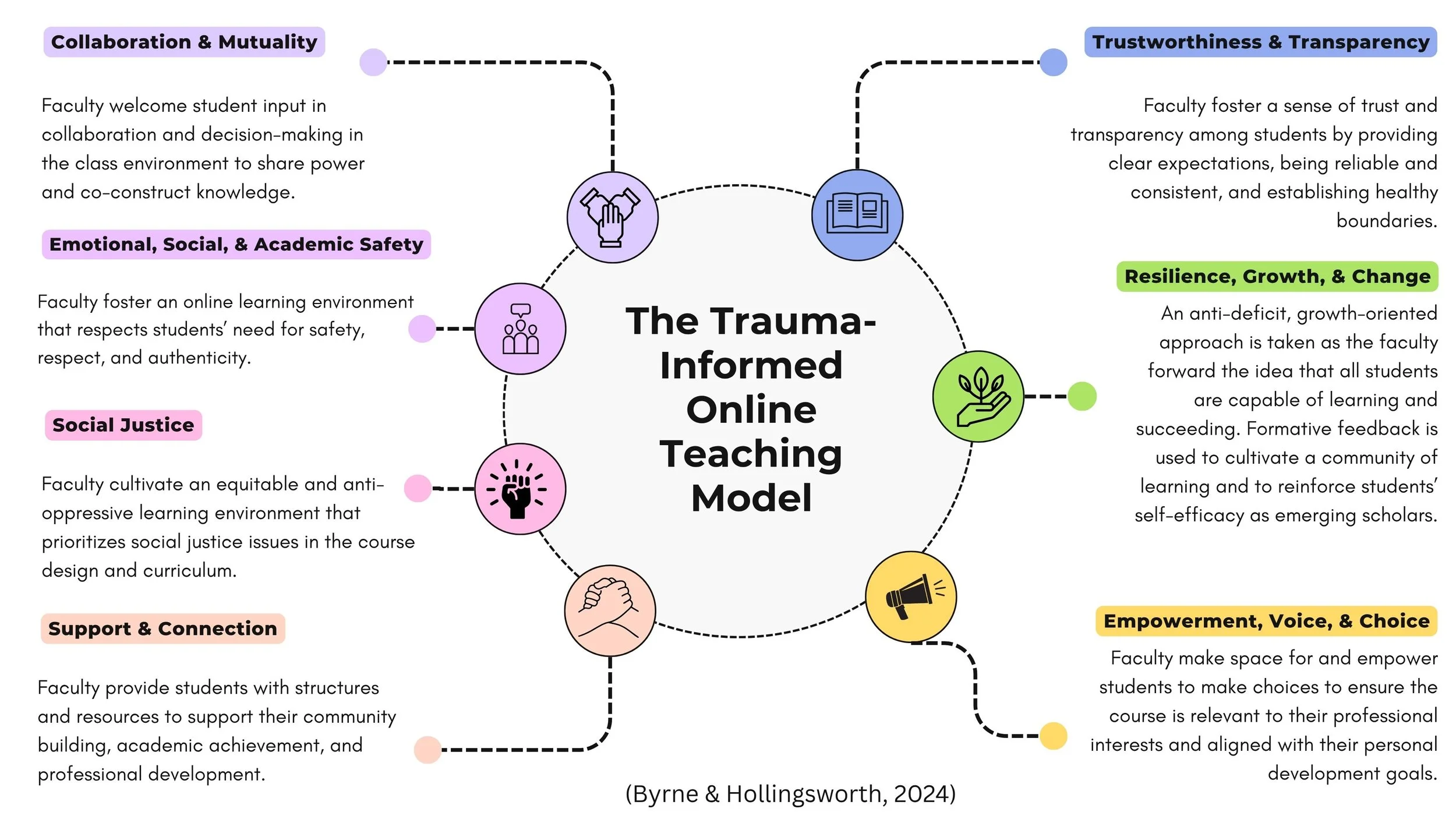
The Trauma-Informed Online Teaching model brings together research on trauma-informed teaching and effective online course design.
The model includes seven connected principles.
Resilience, Growth, and Change
Faculty communicate that students are capable of learning and improving. Students have opportunities to receive feedback, learn from mistakes, revise their work, and build confidence.
Social Justice
Faculty work to create an equitable and anti-oppressive learning environment. Course materials, policies, and learning activities attend to accessibility, representation, and systemic inequities.
Support and Connection
Faculty provide structures that help students connect with the instructor, their classmates, academic resources, and other forms of support.
Trustworthiness and Transparency
Faculty provide clear expectations, communicate consistently, and follow through on their commitments. Course organization, assignment instructions, deadlines, grading criteria, and policies are easy to understand.
Emotional, Social, and Academic Safety
Faculty create a respectful learning environment and avoid unnecessary practices that may shame, isolate, or harm students. Students know how to raise concerns and where to seek support.
Collaboration and Mutuality
Faculty treat students as partners in the learning process. They ask for student feedback, explain their decisions, and create appropriate opportunities for students to help shape the course.
Empowerment, Voice, and Choice
Faculty give students meaningful choices when possible. Students may be able to select topics, examples, activities, assignment formats, or other ways of connecting the course to their goals and interests.
What TIOT Is Not
TIOT is not therapy, clinical treatment, or a way to diagnose students.
Faculty do not need to know which students have experienced trauma in order to use the model. The goal is to design courses that reduce unnecessary stress and give students greater clarity, support, dignity, and agency.
Resources
https://drive.google.com/drive/folders/14GFS_ffN2VKAD28RUyw-LoI_76lQRR90?usp=drive_open
-
Publications
Byrne, V. L., Mondrey, M., Folami, A. O., Moeyaert, M., and Licata-Hoang, C. (2025). Designing a valid and reliable measure of trauma-informed online teaching practices for asynchronous undergraduate courses. Online Learning, 29(4), 237–256. https://doi.org/10.24059/olj.v29i4.5176
Byrne, V. L., and Hollingsworth, J. (2024). A model for trauma-informed online teaching in higher education. In R. A. González and Ş. Orakcı (Eds.), Innovation and Educational Technology Trends in Higher Education. Information Age Publishing.
Select Conference Presentations
Byrne, V. L., Mondrey, M., & Studivant, S. (2026). Designed on a desktop, experienced on a phone: LMS apps and the limits of mobile course access. Paper accepted at the Association for the Study of Higher Education (ASHE) conference, San Juan, Puerto Rico.
Mondrey, M., Byrne, V. L., & Licata-Hoang, C. (2026). From isolation to collective power: Trust-building as practice in asynchronous higher education. Paper accepted at the Association for the Study of Higher Education (ASHE) conference, San Juan, Puerto Rico.
Mondrey, M., Byrne, V. L., Folami, A. O., & Licata-Hoang, C. (March 2026). Guided by care: Strengthening asynchronous student support through advising. Paper presentation accepted at the ACPA 2026 Annual Convention, Baltimore, MD. (Endorsed by the Commission for Academic Support in Higher Education (CASHE)]
Byrne, V. L., Mondrey, M., & Hollingsworth, J. (March 2026). Rooted in care: Adopting trauma-informed practices to support online students. Workshop presentation accepted at the ACPA 2026 Annual Convention, Baltimore, MD.
Mondrey, M., Byrne, V. L., Licata-Hoang, C., & Folami, A. O. (April 2026). Beyond constraints: Constructing a new vision for advisors supporting residential undergraduate students in asynchronous courses. Poster presentation accepted at the American Educational Research Association (AERA) Annual Meeting, Los Angeles, CA.
Byrne, V. L., Mondrey, M., Folami, A. O., Moeyaert, M., & Licata-Hoang, C. (2025). Presenting a valid and reliable measure of trauma-informed online teaching for undergraduate asynchronous online courses. Paper presented at the American Education Research Association (AERA) Conference, Denver, CO.
Mondrey, M., Byrne, V. L., & Folami, A. O. (April 2025). Trauma-informed practices: Priorities for asynchronous courses from HBCU faculty and students. Paper presented at the American Education Research Association (AERA) Conference, Denver, CO.
Byrne, V., Folami, A., & Mondrey, M. (2024). Exploring how HBCU Faculty & Students implement Trauma-Informed Online Teaching Practices. Paper presented at the Association for the Study of Higher Education (ASHE) conference, Virtual.
Byrne, V. L., Mondrey, M., Folami, A. O., & Licata-Hoang, C. (January 2025 – Cancelled). Exploring trauma-informed teaching practices in online asynchronous courses: A review of pilot study results. Presentation accepted at the Institute of Education Sciences (IES) Annual Principal Investigators Meeting, Arlington, VA.
Byrne, V. L., Folami, A. O., & Mondrey, M. (2024). Exploring how HBCU Faculty & Students implement Trauma-Informed Online Teaching Practices. Paper presented at the Association for the Study of Higher Education (ASHE) conference, Virtual.
Byrne, V. L. & Hollingsworth, J. (2023). Posing a model for trauma-informed online teaching in higher education. Presented at American Association of State Colleges and Universities (AASCU) 2023 Academic Affairs Summer Meeting. Baltimore, MD.
Media and Public Scholarship
IES Blog: Spotlight on FY 2023 Early Career Development Grant Awardees: Supporting HBCU Students with Trauma Informed Online Teaching
CBS Interview: Morgan State University Researchers are studying the impact of trauma on student success
Morgan State Press Release: U.S. Department of Education Awards Morgan State University $400K Research Grant to Study Trauma Impacts On Student Performance, Success